

The success of an E-store depends on the website platform on which it is based. To help you get off to the perfect start in your business, we will compare WordPress and Shopify in detail. So, to highlight their differences and help you decide on the best platform selection. But before that, some introduction is required for better understanding.
Selecting a suitable E-commerce development platform is crucial for online selling. Numerous platforms nowadays make selection challenging for merchants and developers. But we will discuss the two most reputable platforms: Shopify vs. WordPress. It is crucial to select a suitable platform before beginning the online selling work.
Table of Contents
An Overview of WordPress vs. Shopify for eCommerce Businesses

What Is WordPress?
WordPress is a free and open-source content management system written in PHP and paired with a MySQL or MariaDB database. Its feature comprises plugin architecture and a template system, referred to within WordPress as Themes.
- WordPress.com
- WordPress.org
If you already running a WordPress website, then continue your eCommerce operations with WordPress. All you have to do is get the WooCommerce plugin, and with simple customization, you can launch your eCommerce store. It results in time and cost-saving operations.
What Is Shopify?
Shopify is a commercial platform that allows business owners to build their online stores without going deep into technical skills. There are two options offered: Shopify and Shopify Plus.
- Shopify: A hosted solution providing online stores to customize storefronts, sell products, and run and grow businesses.
- Shopify Plus: An innovative platform providing a better level of customization, support, and other beneficial features.
Shopify is a perfect choice for those who don’t have a website to run their business. And want a hands-off and specific solution. It even offers numerous advanced features to simplify your daily eCommerce operations. Shopify can be used as a trial version for 3 days, no credit card is needed.
We have discussed the most significant points of difference to help you make a wise decision while selecting CMS.
Need a High-Performing WordPress Website?
We build fast, secure, and SEO-ready WordPress solutions that help your business grow online.
Shopify vs. WordPress: The detailed comparison you must know
Here are the differentiating factors that both allow as per needs.
1.Hosting
Shopify
It is SaaS based operating on a different server and comes fully hosted. It is a great alternative to self-hosted software and brands are moving from traditional hosting to SaaS models. The presence of the website’s security is the actual reason for its popularity. Shopify take complete responsibility of SSL certificates to PCI compliance. This help in reducing the resources on manual website updates.
WordPress
WordPress has two versions WordPress.com & WordPress.org for the E-commerce store. A robust server is required which results in smooth customization. When facing any technical issues simply consult a WordPress Development Company for the development & customization work. That’s why most companies get remarkable business results from hosting their website and manage security. All security patches are integrated by professionals adding a monthly cost.
2.Simplicity
Shopify
Shopify is a simple-to-use online selling platforms, focusing on store merchants and the backend features comprise simple drag and drop. A user can smoothly customize the homepage, navigation with basic clicks. Although Shopify and WordPress have several common features but Shopify offers small changes without developer assistance.
WordPress
WordPress requires technical expertise to set up, and a bit complex to use on a daily basis. It requires deep learning and unless you hold skills or Hire WordPress Developer, you’ll find tough to go with it and carry out changes. WordPress has numerous unique features making it a great choice for E-commerce industry. It lacks drag and drop feature, but its customizing is not tough for store owners having CMS knowledge.
3.SEO
WordPress
With the global audience in mind E-commerce store need proper SEO skills to engage them for higher sales. One of major benefits is the presence of plugins like Yoast SEO, helping website to rank higher. With the presence of local domains, native languages, and currencies, customers love buying from the stores.
Shopify
Shopify SEO lacks skills in comparison to WordPress, they need separate interfaces making complex for store admin. The data is easily shared, but it needs more efforts than the WordPress. Thus, from the SEO perspective if you’ve decided on having multiple stores go with WordPress development. Shopify has functionality of SEO too, but the results are not that favorable. This approach isn’t a perfect customer experience and needs proper changes for desired results.
4. Storefront Design
Shopify
Shopify’s user-friendly theme editor makes storefront design easier. By enabling users to change product displays, page layouts, colors, and fonts without code. In Shopify vs. WordPress, the earlier is a user-friendly design, so the platform is a great option for new users or companies that value convenience.
WordPress
WordPress provides unmatched storefront design versatility. Users can create extremely distinctive stores with particular branding and functionality. Easily by combining themes, plugins, and custom scripting. However, it frequently takes more work, time, and maybe hiring a developer to create a really customized design in WordPress.
4.Customer Support
Shopify
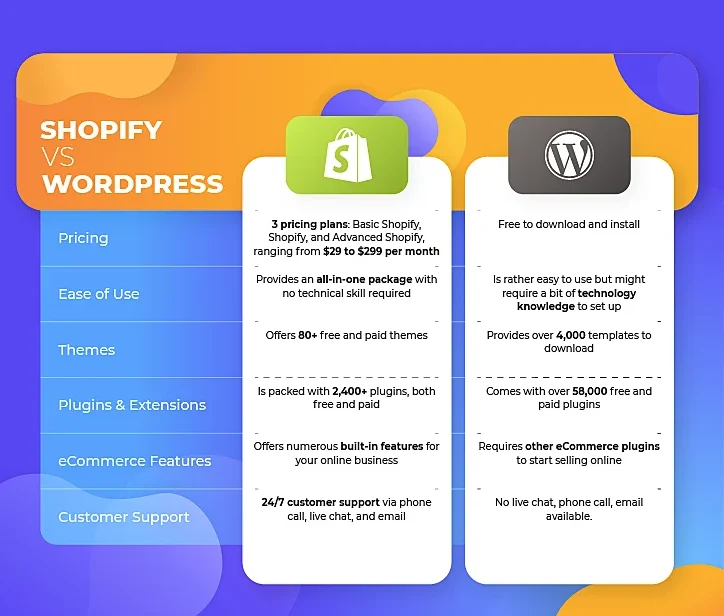
Shopify provide users 24/7 support over phone, email and live chat. Each user is assigned a Merchant manager for personalized support service. In addition, Shopify by default handles updates and security making user less likely to access support.
WordPress
Customer’s get 24/7 WordPress Website Developments support through forums and community. In addition assistance from WordPress’s account management team is provided, but at an extra price. For self-hosted users, most of the support related queries are resolved through hosting provider. Unlike the Shopify, which have flat charges, WordPress offers support packages according to your plan.
5.Design and Customization
WordPress
WordPress is a better option when it comes to design and customization. While Shopify has an array of store themes but options fail in front of WordPress. There are more than thousands of ready-to-use and budget-friendly WordPress themes.
When compared, most WordPress themes are easy to customize without deep coding skills. With the presence of various builders like Beaver Builder and Divi the design work becomes simple. However, expertise in WordPress development services is needed for the dashboard and theme setup.
Once WordPress becomes your forte, you’ll enjoy working with your website’s home page design, menus, store pages, header, and other layouts. In addition, you can integrate sliders and key elements, and grid pages as per your needs within the WordPress theme.
Shopify
Shopify also offers custom options inside the theme setting. To get a similar experience to WordPress, you require coding skills. When needing a custom Shopify website for your online business, you’ll surely need an expert, which appears to be a costly affair.
6.Payment Options
Shoppers prefer eCommerce platforms integrated with advanced payment options with utmost security. Many move to another site or abandon the cart rate when they don’t have their preferred payment gateway. To sell online, a payment gateway is crucial to improve transaction transparency. Major payment gateways for eCommerce include Stripe, PayPal, and Amazon Pay.
Shopify
Shopify smoothly has more than 100 payment gateways for its eCommerce users. It even has its inbuilt gateway named Shopify Payments. This is a savior in situations when you need to set up and manage online payments.
WordPress
For performing payments on the WordPress platform, you’ll just need a payment gateway available with the WooCommerce plugin. The plugin support over 75 payment gateways, consisting of its own: WooCommerce Payments.
Both platforms have their own set of flexibility but WordPress’s all-in-one solution is simple to set up than the Shopify platform.
Multi-Channel Selling
Shopify
Shopify’s smooth integration with social networking sites like Facebook, Instagram, and TikTok, as well as marketplaces like Amazon, eBay, and Walmart, makes it a leader in multi-channel retailing. Store owners can streamline multi-platform commerce by managing all sales channels from a single dashboard.
WordPress
Multi-channel selling in WordPress requires additional plugins. Although WooCommerce facilitates integrations with external sales channels, configuring them frequently calls for several plugins, manual setups, and possible compatibility problems.
Multilingual Support
Shopify
In Shopify vs. WordPress, you can develop several language versions with multilingual capabilities. The feature doesn’t require a lot of customization and is rather easy to use.
WordPress
With the help of plugins like WPML and Polylang, WordPress provides multilingual support. Despite their strength, some plugins need extra setup, and handling of translations. As, it can be more difficult than with Shopify’s integrated solution.
7.Pricing and Value
Cost is a vital factor when it comes to which is a better option WordPress Vs Shopify. So, let’s explore their pricing structure for better understanding.
Shopify
Shopify’s pricing has a simple structure. The service has 3 options:
- Basic Shopify: $39/month
- Shopify: $105/month
- Shopify Advanced: $399/month
To start a new businesses, the Basic Shopify plan offers everything you require to start selling, consisting of an eCommerce website, features for inventory and order management, and a POS system. You even receive a 10% discount if you pay for 1 year on the go and a 20% discount if you pay for 2 years. Plus, Shopify gives 3 day free trial.
WordPress
The WordPress eCommerce website development cost varies greatly as per the custom setup. Here are a few cost estimates when we discuss some typical small business WordPress website:
- Theme: $0–$200
- Domain name: $10–$50 per year
- Hosting: $3–$200 per month
- Plugins: $0–$1,000 (Many plugins charge monthly fees, some charge a one-off fee)
- Security: $50–$500 per month
- Developer fees: $0–$1,000 (one-off cost)
Seeing your business needs, it’s likely that Shopify offers a far cheaper and smooth streamlined facility.
8.Dropshipping Options
Above we have discussed most of the basics to decide between WordPress Vs Shopify. However, we’re missing an important factor – dropshipping options.
Dropshipping isn’t unique and special to entice everyone. But it is perfect for businesses that are not interested in stocking and managing a large number of products. With Dropshipping, a vendor is present to complete the stocking and shipping of your sales process. This ultimately lowers the operational cost of running an eCommerce website.
Both WordPress and Shopify offer dropship using a plugin tool.
Shopify
Oberlo is a popular dropshipping plugin available with Shopify. It helps brands to find products to sell, integrate them into the Shopify store, and instantly start selling.
WordPress
Airdropship is also a popular plugin for WordPress-supported eCommerce stores. This is a free plugin and needs a one-time installation to find the perfect vendor. This will help to complete your sales, and there’s no limitation when it comes to the number of products.
Because both Shopify and WordPress have the facility of plugins to manage your dropshipping facility, it’s difficult to make a choice. The chances are pretty high to get a desired plugin, regardless of the platform that you choose. You can even build the plugin by consulting experts. They will go through your requirements and ensure they are met with complete data security.
Read the Following: https://www.wordpressindia.co.in/blog/wordpress-vs-wix/
Frequently Asked Questions

What is Shopify superior to WordPress?
One of Shopify’s primary advantages is that, in contrast to WordPress, it is hosted automatically, saving you from having to handle server management, hosting, or security on your own.
Is WordPress appropriate for big websites?
Some of the biggest websites on the internet, including those with millions of pages, users, or visits, are powered by the WordPress codebase. Though not all WordPress websites are made for expansion, WordPress is incredibly scalable.
How many products is Shopify able to manage?
There are no restrictions on how many products you may offer in your Shopify store. You are not billed according to the quantity of data or images you upload or the number of people who browse your store online. Your logo, brand colors, and slogan are among the brand assets that you may add and maintain.
How do CMS and e-commerce vary from one another?
CMS serves a wide variety of websites by concentrating on the generation and administration of information. E-commerce platforms, which prioritize transactional features, are designed for companies that offer goods or services online.
What distinguishes corporate software from CMS?
While enterprise CMSS applications, IOT devices and other platforms can distribute materials, traditional CMS are usually prohibited to give materials to websites. Traditional systems lack some of the more sophisticated security, encryption and compliance facilities found in business CMS platforms.
Wrapping Up:
WordPress & Shopify are both renowned frameworks helps to build E-commerce selling websites. These two frameworks have remarkable features present in it making it perfect for merchants. Build web applications on WordPress to get the best and engaging user experience. The best thing is the security & ease of use of the CMS for website development.
Both platforms have their own set of pros & cons. Therefore, the decision to select between the two CMSs completely depends on the business needs. Major factors for selection are cost, security, hosting, support, and available resources. If we check major features and WordPress is a far better platform to build website. You can hire WordPress developer from reputed agency like WordPressIndia for smooth migration, upgrade and boost conversion rate. This will make you far ahead of the competitors with minimum efforts.


